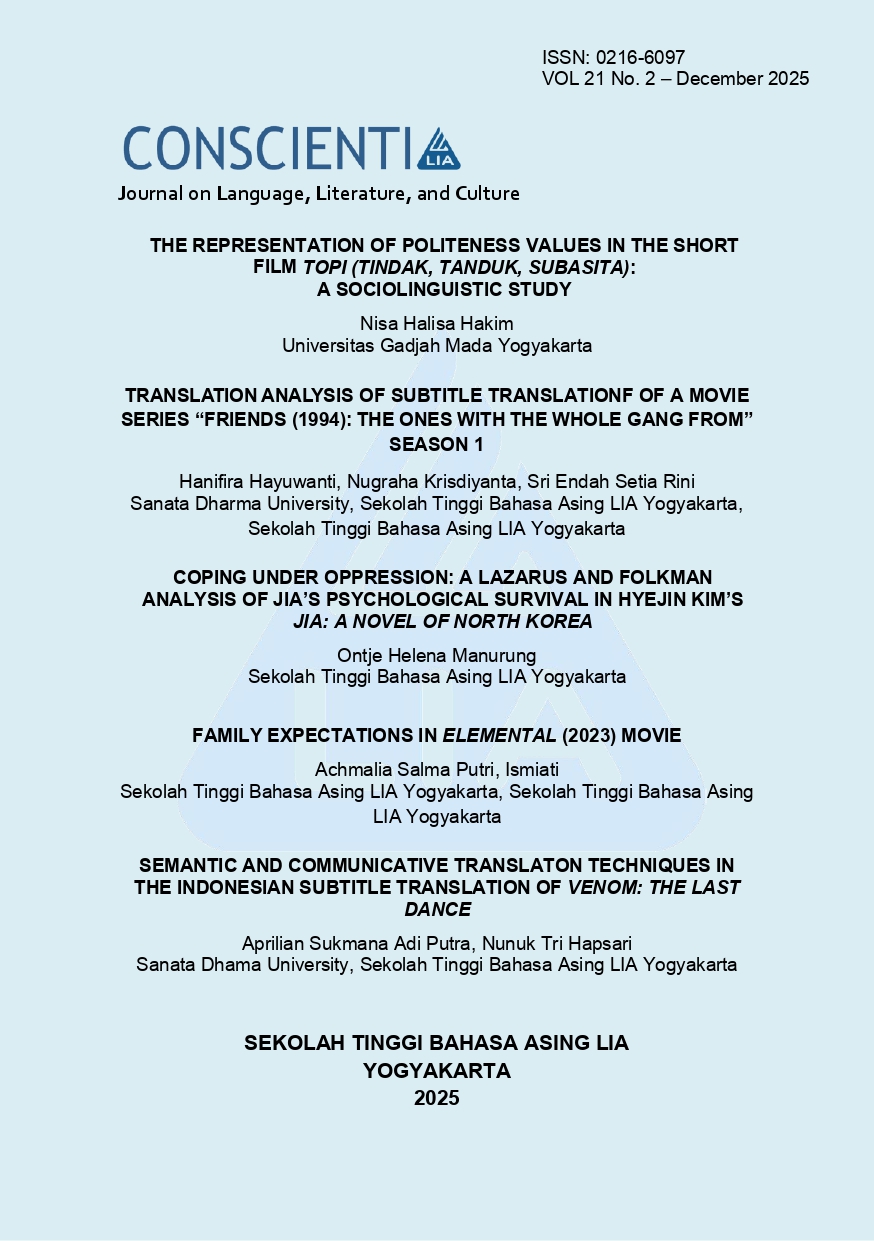
THE REPRESENTATION OF POLITENESS VALUES IN THE SHORT FILM TOPI (TINDAK, TANDUK, SUBASITA) : A SOCIOLINGUISTICS STUDY
Article Sidebar
Manners,
Javanese Culture,
Film,
Sociolinguistics
Main Article Content
Abstract
Politeness is an essential aspect of social interaction, particularly in Javanese culture, which strongly emphasizes manners and etiquette. The short film TOPI (Tindak, Tanduk, Subasita), produced by Paniradya Kaistimewan Yogyakarta, portrays these cultural values through the language and gestures used by its characters. This study employs a qualitative descriptive method aimed at analyzing the values of politeness represented in the short film TOPI through the dialogues and gestures of its characters, grounded in Penelope Brown and Stephen C. Levinson’s (1987) politeness theory as the analytical framework.
The analysis identified five positive politeness strategies, one negative politeness strategy, three bald-on-record strategies, and one off-record strategy. These findings demonstrate how language and gestures in the short film reflect Javanese manners within family and community interactions. Furthermore, this study highlights a contemporary phenomenon, how Javanese values are preserved through digital media. Short films published on YouTube serve not only as entertainment but also as a medium for character education, language learning, and a concrete example of the preservation of Javanese culture in the modern era.
Overall, this research underscores the role of audiovisual media in strengthening cultural education and expanding the study of politeness phenomena within a sociolinguistic context.
Article Details

This work is licensed under a Creative Commons Attribution-ShareAlike 4.0 International License.